

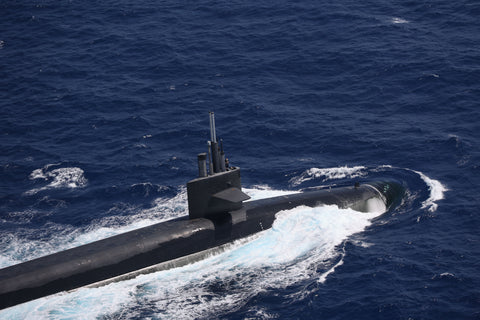
How Deep Can a Submarine Go?
Publicly acknowledged sources put the operating depth of most U.S. Navy attack submarines at around 800 feet, with estimated crush depths ranging from roughly 1,600 to 2,400 feet depending on the class. However, the Navy classifies the exact maximum depth of its submarines, so these numbers represent the deepest figures confirmed in open-source reporting rather than the true operational ceiling.
The notion of human exploration has always been interwoven with a fascination for depths—be it the perils of the Mariana Trench or the secrets lurking in the abyss of space. In the terrestrial domain, the U.S. Navy has continually pushed the boundaries of undersea technology, crafting vessels capable of descending to jaw-dropping depths. This post breaks down what's publicly known about Navy submarine depths, the physics behind submersion, and why the deepest numbers remain classified.
Submarine Depth Reference Table
Submarine depth is typically described using three terms: test depth, operating depth, and crush depth.
- Operating depth: The maximum depth at which a submarine is designed to perform routine operations safely and repeatedly.
- Test depth: The depth to which a submarine is tested during sea trials, typically set as a safety margin below the theoretical maximum. This is often used interchangeably with "operating depth" in public reporting.
- Crush depth: The estimated depth at which water pressure would cause the hull to structurally fail. This figure is rarely, if ever, officially confirmed by the Navy.
Below are publicly acknowledged figures for major submarine classes, compiled from open-source defense reporting. Exact classified figures may differ.
|
Submarine Class |
Country |
Publicly Acknowledged Operating/Test Depth |
Estimated Crush Depth |
|---|---|---|---|
|
Los Angeles-class |
United States |
~650–950 feet |
~1,600–2,000 feet (estimated) |
|
Virginia-class |
United States |
~800 feet |
~1,600–2,000 feet (estimated) |
|
Ohio-class |
United States |
~800+ feet |
~1,600–2,400 feet (estimated) |
|
Seawolf-class |
United States |
~800+ feet |
~2,400 feet (estimated) |
|
Yasen-class |
Russia |
~1,970 feet (claimed) |
Not publicly confirmed |
|
Alfa-class (retired) |
Soviet Union/Russia |
~2,300 feet (claimed, titanium hull) |
Not publicly confirmed |
Note: These figures are drawn from publicly available defense sources and industry estimates. Actual classified specifications may vary.
The Evolution of Naval Submersibles
To understand today's Navy submarines, it helps to trace their lineage. The first major leap in submersible technology came during WWII, when diesel-electric subs extended the operational range of naval fleets, though their speed and depth remained limited. The Cold War arms race that followed fueled the development of nuclear-powered submarines, granting unprecedented endurance and stealth beneath the waves.
Each generation of submarines has built on the last, integrating streamlined designs, advanced materials, and deeper-diving capabilities. These undersea vessels reflect a cumulative growth in engineering expertise, with each design informed by the sorties before it.
How Does Submarine Depth Work? The Physics of Submersion
Submarine depth is governed by two core principles: buoyancy and pressure. When a submarine descends, it displaces water, and Archimedes' principle applies—there's an upward buoyant force equal to the weight of the water displaced. The submarine's ballast system manages seawater intake and expulsion to maintain a desired depth without becoming too heavy to resurface.
The depth a submarine can reach is ultimately limited by how much hydrostatic pressure its hull can withstand. The deeper the dive, the greater the pressure on the hull. This demands rigorous materials engineering, with submarine hulls typically built from high-strength steel or, in select cases, titanium, designed to endure immense pressure gradients while keeping the vessel watertight.
Why Is Submarine Depth Classified?
The U.S. Navy discloses general operating parameters for its submarines but withholds precise maximum and crush depth figures for national security reasons. Publicly acknowledging an exact depth ceiling would give adversaries a clear benchmark for designing weapons, sensors, and detection systems capable of countering U.S. submarines at their most vulnerable operating range.
This secrecy extends to test depth results, hull material specifications, and the outcomes of deep-dive trials. What the Navy does disclose tends to be broad categorizations—such as noting that a class operates at "in excess of 800 feet"—rather than a specific figure. This kind of rounded, conservative language allows the public and allied nations to understand general capability without revealing operational limits that could be exploited.
Defense analysts and naval historians often rely on indirect evidence to estimate real figures, including hull material properties, historical incidents, and comparisons to publicly tested vessels like the bathyscaphe Trieste. Even so, these remain estimates rather than confirmed facts. As a matter of policy, the true crush depth of an active submarine class is considered one of the most closely guarded figures in naval defense, and it's unlikely the public will ever know it with certainty. This is a deliberate strategic choice, not an oversight, and it's unlikely to change as submarine technology continues to advance.
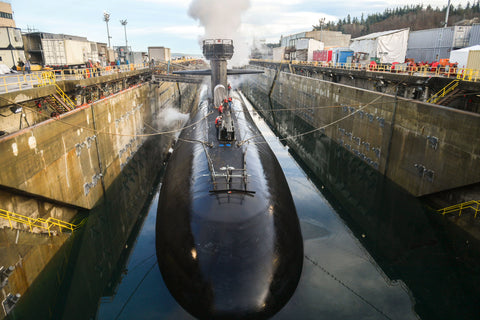
Breaking Down Depth Records by Class
U.S. Navy submarines are classified into multiple categories, each optimized for a particular naval strategy. The Virginia-class fast attack submarines emphasize versatility and speed, with reported maximum depths reaching 800 feet—deep enough to generate crushing pressure well beyond human survival limits.
The Seawolf-class and Ohio-class guided-missile submarines, designed for stealth and firepower, reportedly operate in excess of 800 feet, though precise figures remain classified. The exact "crush depth"—the point beyond which the hull is expected to fail—is guarded information for every active class. Knowing the deepest a submarine can operationally go is one thing; understanding how it performs under extreme pressure is another matter entirely.
The Pressures of Protection
At depths of several hundred feet, external pressure becomes a formidable engineering challenge. Hull construction requires a delicate balance: strong enough to withstand tons of pressure per square inch while remaining light enough for the vessel to travel efficiently.
Submarines aren't just built to withstand these pressures—they're also designed to detect environmental changes that might indicate depth exceeding recommended limits. Hydrophones, sonar, and advanced sensor arrays work together to give crews the data needed to make informed decisions about descent and ascent.
Deepest Dives in History: Submarine Depth vs. Ocean Depth
While Navy submarines operate within classified but relatively shallow limits compared to the ocean's full depth, a handful of specialized vessels have pushed far deeper for scientific and record-setting purposes.
- Trieste (1960): This bathyscaphe reached the bottom of the Mariana Trench's Challenger Deep, approximately 35,800 feet down—the first crewed vessel to do so. It was purpose-built for a single research dive, not for military operations.
- Victor Vescovo (2019): American explorer Victor Vescovo piloted a submersible to 35,853 feet, the deepest recorded human dive in history. While this wasn't a U.S. Navy vessel, it illustrates how deep specialized submersibles can venture into the ocean and directly answers "how deep can a submarine go?"—just not "how deep can a Navy submarine go?"
These examples highlight an important distinction: military submarines are engineered for endurance, stealth, and repeatable operations at moderate depths, while research submersibles like Trieste are built for a single, extreme descent with no operational requirement beyond reaching the bottom and returning safely. The limiting factor for military submarines isn't how deep they could theoretically go with different engineering, but the trade-off between depth, speed, stealth, and mission endurance.
Submarines in Scientific Discovery
While the primary mission of Navy submarines is defense, they've also played crucial roles in scientific discovery. The USS Nautilus was the first vessel to travel from the Pacific to the Atlantic beneath the Arctic ice, opening new frontiers in exploration and geopolitics. Today, submarines equipped with laboratories enable researchers to study marine biology and geology in remote, inaccessible underwater territories.
Conclusion
The depth to which a Navy submarine can go reflects a measure of human achievement—one that encapsulates the intersection of national defense, engineering innovation, and the human drive to extend our reach. From the kilometer-deep exploits of the Trieste to the stealthy undersea operations of modern nuclear submarines, the story of undersea exploration is one of continuous advancement.
With each passing year, Navy submarines redefine the limits of what's publicly known about operating in the ocean's most extreme environments. The precise numbers may remain classified, but the engineering behind them continues to push forward.
Frequently Asked Questions
How deep do submarines go?
Publicly acknowledged Navy submarines generally operate at depths around 800 feet, while specialized research submersibles like Trieste have reached the ocean floor at nearly 36,000 feet. Generally speaking, how deep can a military submarine go depends heavily on the vessel's design and mission.
What happens if a submarine goes too deep?
If a submarine exceeds its crush depth, water pressure surpasses what the hull can structurally withstand, causing rapid and catastrophic hull failure. This is why submarines are engineered with a safety margin between their operating depth and their theoretical crush depth.
How deep can WW2 submarines go?
WWII-era diesel-electric submarines typically had operating depths of around 200 to 300 feet, significantly shallower than modern nuclear submarines. Their limited depth capability was due to less advanced hull materials and construction techniques compared to today's high-strength steel and titanium designs.
How deep can a nuclear submarine go?
Modern nuclear submarines routinely operate at depths of 800+ feet and again, the actual depth is classified. The crush depth is reported to be around 1,600+ feet on most nuclear subs, but yet again, that information is classified so it is hard to get a precise answer on how deep can nuclear submarines go.
6 comments
The question should be, how deep can it dive and then safely surface. When I was in, the publish maximum depth was 300ft
The question should be, how deep can it dive and then safely surface.
My dad was on a Subamarina. I have been interested
What depth can a sub dive normally
May who this may concern I’m a great uncle of a nephew who just served on a nuclear submarine now I’m very interested in the submarine I was always interested in submarines
I am 90 years old. Over 60 years ago I spent a couple of months submerged in a sub. We landed in Scotland. That was all for the navy. Next I spent a number of years working for NASA on the Apollo spacecraft. That was very rewarding. But enough ancient history. Keep the faith! …dan.