


What Do Army Shoulder Cords Mean?
The Army blue cord signifies membership in the infantry, and it's currently the only shoulder cord authorized for wear on any Army uniform per AR 670-1. Other colored cords—representing branches like artillery and armor—exist, but they require special authorization from a unit commander for particular events or duties. Below, we'll break down the meaning of Army shoulder cords, their history, how they're worn, and what each color represents.
Although the infantry cord stands out as the most recognized, several Army shoulder cords can be worn on an Army uniform, and there's a big difference between them. Most, however, require a special duty assignment, which we'll cover below.
What Does the Blue Cord Mean in the Army?
The blue cord Army soldiers wear signifies membership in the infantry. According to the most recent version of Army Regulation 670-1 (AR 670-1), the infantry blue cord is the only shoulder cord currently authorized for wear on any Army uniform. The Army Shoulder Cord is intended to be worn on the Class A dress blue uniform jacket or Class B shirt.
Simply put, if you see a soldier wearing a blue cord on their uniform, it signifies they are likely in the infantry. The other colored cords, corresponding to different Army branches, can be authorized by unit commanders to be worn during particular events, but they don't carry the same standing authorization as the infantry cord.
What Is the History Behind Army Shoulder Cords?
The history of shoulder cords in the U.S. military dates back to World War II, when they were worn as a mark of distinction denoting membership in a combat unit or participation in a specific campaign. The U.S. Army did not really embrace shoulder cords until around this period, though the practice evolved from broader military traditions found throughout the world.
Over time, their meaning has expanded to encompass a wider array of significances, yet the ethos of recognition and accomplishment remains the same. In the vast sea of military uniforms, the shoulder cord is a small but powerful detail, often unspoken in its significance. This slender adornment carries with it a language of its own, communicating a soldier's feats, affiliations, and honors.
How Is an Army Shoulder Cord Worn?
The shoulder cord is worn on the right shoulder, passed under the arm and over the right shoulder under the shoulder loop, then secured to the button on the shoulder loop. To attach the cord, personnel will attach a 20-ligne button to the right shoulder seam, 1/2 inch outside the collar edge.
What Do the Different Army Shoulder Cord Colors Mean?
Each shoulder cord color represents different achievements and roles within the Army. As previously mentioned, the Army only authorizes one cord for standard wear—the infantry blue cord—but other colors exist for special occasions or duties when authorized by local commanders. It's not just the color that tells a story; the way the cords are braided and the arrangement of knots also carry deep symbolic meaning.
|
Cord Color |
Branch/Meaning |
Authorization |
|---|---|---|
|
Blue |
Infantry |
Authorized for standard wear per AR 670-1 |
|
Red, Black, and Gold |
Artillery |
Requires local commander authorization for special occasions or duties |
|
Yellow |
Armor units |
Requires local commander authorization; reflects the traditional color of armored cavalry |
|
Gold |
Aiguillette for aides to the president, vice president, and other senior officials |
Worn on the left shoulder per specific billet assignments |

Infantry Blue Cord
Infantrymen are known for their blue cord, signifying their role as the backbone of the U.S. Army. This cord is reserved for those who have completed the rigorous training and subsequently served in various infantry roles. It is a personal qualification identifier, and not a symbol of combat service.
Artillery Red, Black, and Gold Cord
The red, black, and gold cord indicates the wearer is in an artillery unit, reflecting the core values and history of the artillery as a crucial force on the battlefield. As mentioned earlier, the Army does not authorize this cord for standard wear like the infantry cord; however, the uniform regulation allows local commanders to authorize soldiers to wear it for special occasions or duties.
Armor Units' Traditional Yellow Shoulder Cord
The yellow cord means the wearer is in an armor unit, a nod to the color that has identified armored cavalry for many years.
What Do the Knots on an Army Shoulder Cord Mean?
Knots on an Army shoulder cord carry special symbolism, with each knot representing a specific accomplishment achieved by the wearer. Multiple knots could signify more advanced training or a longer tenure in a particular unit.
Looking Forward
The tradition and symbolism behind Army shoulder cords are enduring, but they are not static. The cords continue to adapt, incorporating new meanings and conversations reflective of the modern military landscape.
Frequently Asked Questions
Q: Can any soldier wear a colored shoulder cord besides blue?
A: Yes, but only with authorization from a local unit commander for a specific event or duty. The infantry blue cord is the only one authorized for standard wear under AR 670-1.
Q: What is an aiguillette, and how does it differ from a shoulder cord?
A: An aiguillette is a gold-colored cord worn on the left shoulder by military aides to senior officials, including the president, vice president, and secretary of defense. Unlike branch cords, aiguillettes signify a specific duty assignment or billet rather than a combat branch.
Q: Can a soldier wear more than one cord at a time?
A: No. Per AR 600-8-22, only one fourragère, lanyard, aiguillette, or cord is authorized for wear on each shoulder.
Conclusion
Shoulder cords are more than mere fabric; they're weaves of history and identity. These seemingly simple adornments have the power to bond wearers to their past, present, and future as soldiers, reminding each individual of their unique contribution to the collective power of the U.S. Army and communicating that story to the world.
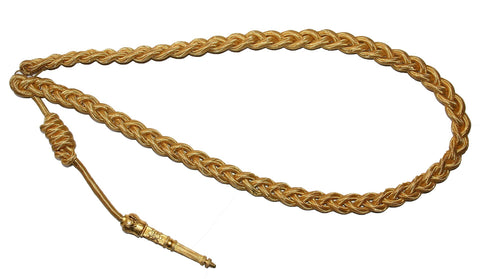
The "aiguillette" is worn on the left shoulder by military aides to the president and vice president of the United States. It is also worn by military assistants to the secretary of defense and the secretary of homeland security, aides to the service secretaries, military attachés, general staff corps officers, and aides to flag officers. The Army uses gold-colored cords for these positions, while other services wear aiguillettes specific to particular billets a service member occupies.
Permanent and temporary fourrageres and lanyards may be worn on the service/dress uniform per the provisions of AR 600-8-22. Only one fourragere, lanyard, aiguillette, or cord is authorized for wear on each shoulder.
Updated September 2026.
7 comments
I still have the orange signal Corp lanyard. It wasn’t authorized but allowed by commander for SOME ceremonial occasions.
As for what colors can be worn by a particular unit or MOS, we recommend you check with your unit leadership and check the regs. Many units have unit specific uniform items that can only be worn when you are a part of that unit. But it is best to check with unit leaders and the regulations governing the wear of these items. Especially because uniforms are constantly changing it seems.
Only current infantry personnel can wear the blue cord. Once you leave the infantry, you lose the cord. Pretty sure based on experience, but check the regs and with your unit leaders.
I was infantry for a number of years then went over to refueling, so; do I still wear the blue cord on my dress blues?
Is the red shoulder cord for Medical MOS & the Olive for Quartermaster MOS?
Thanks
Al Borvice
Is the signal corps orange cord still a cord that can be worn by that unit of the Army?
When I was in the 82nd ABN in 1970-71 on our dress uniform we had a green lanyard / Rope and a red one was this correct?